Search This Blog

Monday, February 3, 2020

Kindergarten Indigenous Immersion Policy

Drawing on varied evidence from indigenous language programs, the several articles I examined made the case that immersion programs are vital to early learners. They showcase the benefit of these immersion programs starting at a young age and  illustrate how traditional indigenous values are infused into language programs and can be embedded into the students play. These programs help to build positive strong identities in indigenous and non-indigenous students and their communities. I will provide an outline and rationale for the framework on providing indigenous language to our young students and how this not only emphasizes the interconnectedness to our environment but also supports full day kindergarten experiential learning.  

The research and this subsequent information will highlight four crucial components for Kindergarten Indigenous language programs; challenges, benefits, best practises, and resources.   While no ideal model is possible due to the diversity of languages and community contexts within Canada, there are several factors that have been identified through language acquisition research and years of practice in Indigenous Language programs that can be closely linked to success.

“By the year 2000 all schools will offer Native students the opportunity to maintain and develop their tribal languages and will create a multicultural environment that enhances the many cultures represented in the school” (Reyhner, 2010) (This goal is still far from fruition despite the work of immersion schools outlined in this write up). For many Aboriginal peoples, learning is a lived experience best absorbed through activities such as; learning/talking circles, storytelling, discussions, demonstrations, cooperative learning, role modeling, peer tutoring, and hands-on experiences. My goal is to make the case that kindergarten immersion programs can be vital to healing the negative effects of colonialism and assimilation schooling and that policies need to be in place to support this.

Challenges
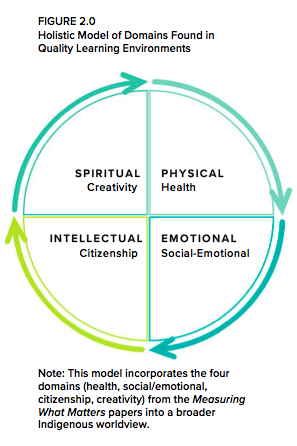
Typical assessment mechanisms employed within public education include formative test-taking measures, standardized tests, written evaluations, teacher-centered feedback, and the provision of formal grades/percentages.  These types of curriculum delivery and assessment is ill-matched with Aboriginal ways of knowing and learning. First Nations children may tell a story without an introduction, without building a context, or in a non-linear sequence. Their story retellings may elicit less language than play-based language samples. Assessing a narrative according to the structural features of a different set of norms can result in misattribution of cognitive delay or deficit. (Ball,2006) Its imperative for immersion programs to devise an assessment strategy that aligns with indigenous customs and values.  Some examples of assessment strategies that are indigenous centered are; conferences, portfolios, journals, photo essays, and performances. (Toulouse, 2001) They should provide opportunities for students to express learning through their spiritual, physical, emotional and intellectual domains. 

Customs
In mainstream schools, students are expected to speak in a wide range of situations. Some of these may be unfamiliar or uncomfortable for First Nations children.  In many First Nations communities, listening and observing are valued as much as talking. It is important to be aware that people from different cultures may have been socialized into different sets of norms for appropriate ways to use language interactively. For example, First Nations children’s interactional norms may not match situations or expectations in school. Their responses, often in the form of hesitation or silence, may be misinterpreted as lack of comprehension, inability to respond correctly, lack of attention or even insolence. (Ball, 2006) Being aware of these norms will allow for further understanding and will help to modify the kindergarten language approach to learning. 

Best Practises
Aboriginal pedagogy stresses the importance of experiential learning, service learning, and out-of-school experiences.  The full day kindergarten program in Ontario supports this pedagogy and endorses student led learning which will provide opportunities for indigenous languages to be included in their everyday experiences.  It is not enough, however, to simply introduce the native language if a school‟s curriculum remains unchanged (Nevins, 2004). Just translating a non-Native curriculum into the Native language and focusing on vocabulary and grammar is in no way part of a decolonization agenda. (Reyhner, 2010) As Wayne Holm (2006), former director of the Navajo-English bilingual Rock Point Community School, noted, “If school is to be relevant, it has to deal with the realities of the land, the animals, and the people” As a way of emphasizing an interconnectedness with our environment and our relationship to the world, Deloria and Wildcat (2001) advocate both experiential learning involving example and observation and a focus on the importance of reciprocity and giving back. (Reyhner, 2010)

Involvement 
Parent and community involvement is crucial and should be embedded within the policy.  A plethora of research has confirmed the notion that parent/caregiver involvement in school has positive effects on a students’ school experience, including increased academic achievement, better attendance, improved behavior, and a stronger motivation to succeed (Darch et al, 2004). Preston suggests that in turn, education leaders need to develop school-home strategies that are in line with the dynamics of Aboriginal families and their extended members. This could include using technological tools for communication, inviting them in to classroom presentations, sharing their knowledge and keeping them updated and informed. 

Policy
The decision-making about immersion program should be based around the  stakeholders of the Indigenous language community. How decisions are made, and control is exercised, will vary from community to community however, depending on the governance practices of each group.  Community engagement, or participation, has also been found to have positive effects on program. (De Korne, 2010)Programming must be locally controlled and include input, design, and delivery by Aboriginal Peoples. Successful immersion programming must be derived from an Aboriginal perspective (Morcom, 2017 p. 15).

Start Early
  Generally, it appears that if a child enters immersion programming early, detriment to mainstream language development is unlikely to occur (Raham 2004; Usborne et al, 2011) The critical period,when children are able to pick up languages with little instruction through exposure, lasts until about age 12, so the earlier programs start the more time they have to acquire the language. (De Korne, 2010). Ball (2005) claimed that early childhood educational services should be the nucleus of Aboriginal communities. This is why it's crucial to start immersion for students in Kindergarten.


Reyhner, J. (2010) Indigenous Language Immersion Schools for Strong Indigenous Identities. Heritage Language Journal, 7(2) Retrived from https://www.afn.ca/uploads/files/education/20._2010_reyhner,_indigenous_language_immersion_schools_for_strong_indigenous_identities.pdf pg 138- 149. 

 Monk, J. (2017). The Power of Immersion and Bilingual Schools for Indigenous Language Revitalization. Retrieved from: https://www.socialconnectedness.org/the-power-of-immersion-and-bilingual-schools-for-indigenous-language-revitalization/ Accessed July 17, 2019. 

Morcom. L. Weighing the Benefits of Aboriginal Language Immersion. Canadian Journal of First Nations Studies.

Ball, J, Bernhardt, B, and Deby, J..  (2006) . Implications of First Nations English Dialects for Supporting Children’s Language Development.  World Indigenous Peoples’ Conference on Education, 2005.  Retrieved from;  http://ecdip.org/docs/pdf/WIPCE%20Dialectics%20Paper2006.pdf 

Preston, J. (2014). Early childhood education and care for Aboriginal children in Canada. [Online] Retrieved from; https://movingchildcareforward.ca/images/policybriefs/MCCF_aboriginal_childcare_canada.pdf

 De Korne, H.  (2010). Indigenous Language Education Policy: Supporting Community-
Controlled Immersion in Canada and the US.  Language Policy, 9, 115-141

Toulouse, P.M. (2001)  Achieving Aboriginal Student Success: A Guide for K to 8 Classrooms. Portage & Main Press  

Friday, January 31, 2020

Self Governence


Indigenous peoples practiced their own forms of government for thousands of years before the arrival of European and other settlers in what is today Canada. These forms of government reflected the economic, social and geographic diversity of Indigenous peoples, as well as their cultural practices and spiritual beliefs.  
The struggle for self-government has been ongoing for a long time. Prior to 1973, the Government of Canada refused to even entertain the concept of Indigenous self-government. It was the Supreme Court of Canada's ruling in Calder that caused a shift in policy.


Christou says that for self- government of Indigenous control of education to become a reality, we must have well prepared teachers who are able to work within their communities to develop curriculum and pedagogy that best meet the local needs.  (Morcomet al 2017).
I started to question how can I help support self governance of Indigenous communities?  One way is by becoming more informed about the two education agreements that involve over 35 indigenous communities.  


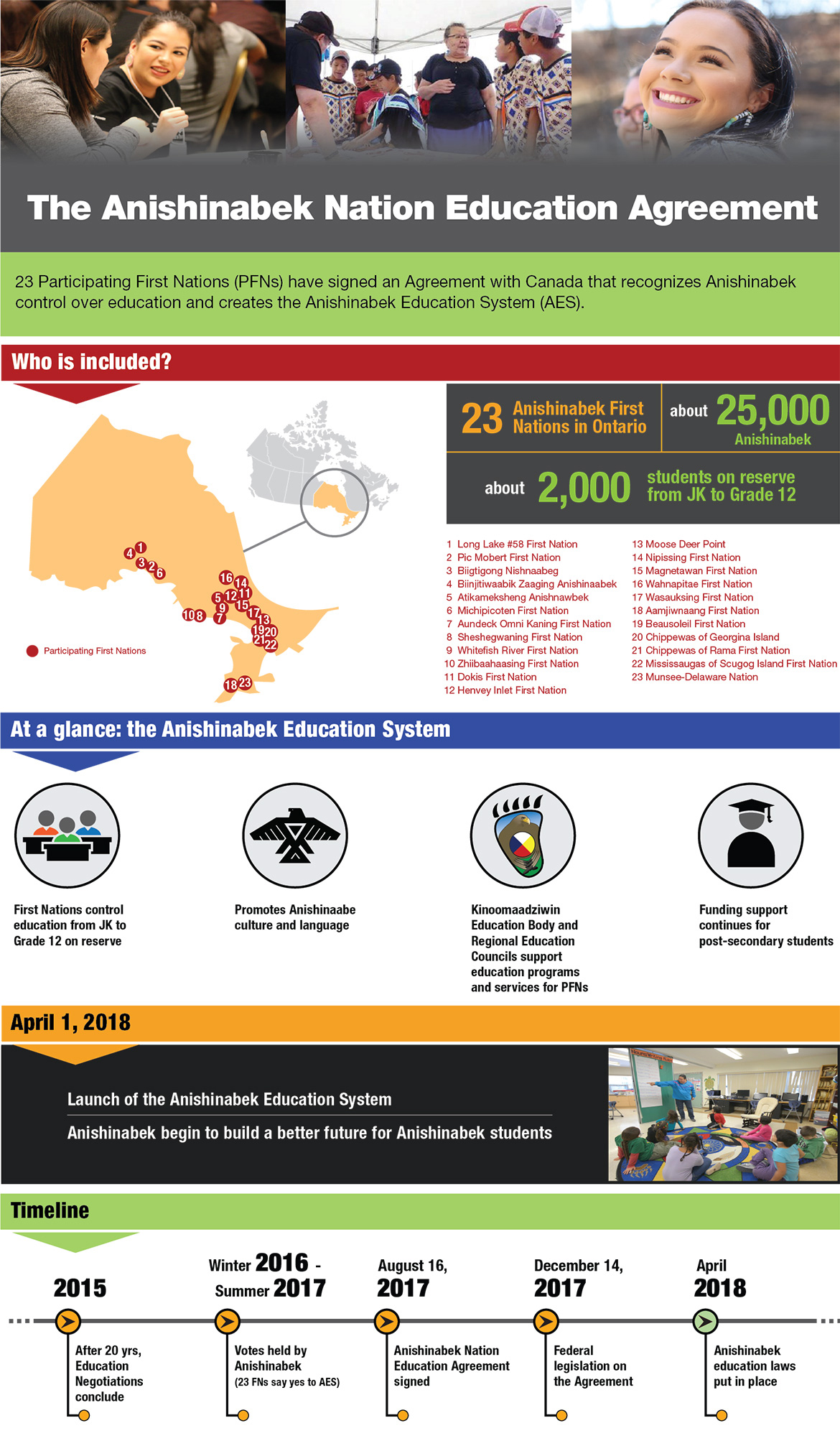
The Education Agreement in Nova Scotia and the Anishinabek Nation Education Agreement in Ontario.Another way is by having discussions with colleagues and peers about self governance. Of of my favourite quotes that I came across in the Federal Policy Guide while doing my research was the answer to Why do Aboriginal Peoples Want to Self Government?...  


As a teacher are you willing to work with and along side knowledge keepers, indigenous leaders and elders to make the much needed change for the education of all indigenous students in Canada?

Perhaps a more accurate question would be “Why do Aboriginal Peoples want self-government back?” Long, long before European contact, Aboriginal Peoples had their own established political systems and institutions – they were self-governing. And Aboriginal Peoples have been trying to get back the right to govern themselves and preserve their cultural identities since the British North America Act in 1867." 


Federal Policy Guide: Aboriginal Self-Government – The Government of Canada’s Approach to Implementation of the Inherent Right and the Negotiation of Aboriginal Self-Government. (2015) 

Morcom, L. A., Freeman, K. & Davis, J. (2017). Rising like the thunderbird: The reclamation of Indigenous teacher education. In T. Christou (Ed.), Canadian Teacher Education: A Curriculum History (pp. 23-40). New York: Routledge. Permanent Link - http://proxy.queensu.ca/login?url=http://search.ebscohost.com/login.aspx?direct=true&db=nlebk&AN=1574385&site=ehost-live&ebv=EB&ppid=pp_23

 Image.  Available at https://www.rcaanc-cirnac.gc.ca/eng/1502376429223/1542741448397


For self-government and Indigenous control of education to become a reality, we must have well prepared teachers who are able to work within their communities to develop curriculum and pedagogy that best meet local needs. Teachers and admin- istrators have effectively accomplished this in the development of educa- tional systems under SGAs such as the Mi’kmaq Kinamatnewey. 72 Sadly, aggressive assimilation has taken a toll on educational practices in some Indigenous communities. To achieve self-government, “the capacity that has been lost over the generations needs to be restored, so that Aboriginal families and communities can reassert their rightful place in educat- ing their children and in Canadian society.” 73 Indigenous education sui generis means not only including Indigenous content and pedagogy, but also having the freedom to choose how education will be conducted and having the capacity to carry out the development of appropriate educa- tional opportunities.
or self-government and Indigenous control of education to become a reality, we must have well prepared teachers who are able to work within their communities to develop curriculum and pedagogy that best meet local needs. Teachers and admin- istrators have effectively accomplished this in the development of educa- tional systems under SGAs such as the Mi’kmaq Kinamatnewey. 72 Sadly, aggressive assimilation has taken a toll on educational practices in some Indigenous communities. To achieve self-government, “the capacity that has been lost over the generations needs to be restored, so that Aboriginal families and communities can reassert their rightful place in educat- ing their children and in Canadian society.” 73 Indigenous education sui generis means not only including Indigenous content and pedagogy, but also having the freedom to choose how education will be conducted and having the capacity to carry out the development of appropriate educa- tional opportunities.
For self-government and Indigenous control of education to become a reality, we must have well prepared teachers who are able to work within their communities to develop curriculum and pedagogy that best meet local needs. Teachers and admin- istrators have effectively accomplished this in the development of educa- tional systems under SGAs such as the Mi’kmaq Kinamatnewey. 72 Sadly, aggressive assimilation has taken a toll on educational practices in some Indigenous communities. To achieve self-government, “the capacity that has been lost over the generations needs to be restored, so that Aboriginal families and communities can reassert their rightful place in educat- ing their children and in Canadian society.” 73 Indigenous education sui generis means not only including Indigenous content and pedagogy, but also having the freedom to choose how education will be conducted and having the capacity to carry out the development of appropriate educa- tional opportunities. 74
For self-government and Indigenous control of education to become a reality, we must have well prepared teachers who are able to work within their communities to develop curriculum and pedagogy that best meet local needs. Teachers and admin- istrators have effectively accomplished this in the development of educa- tional systems under SGAs such as the Mi’kmaq Kinamatnewey. 72 Sadly, aggressive assimilation has taken a toll on educational practices in some Indigenous communities. To achieve self-government, “the capacity that has been lost over the generations needs to be restored, so that Aboriginal families and communities can reassert their rightful place in educat- ing their children and in Canadian society.” 73 Indigenous education sui generis means not only including Indigenous content and pedagogy, but also having the freedom to choose how education will be conducted and having the capacity to carry out the development of appropriate educa- tional opportunities.

Wednesday, January 22, 2020

Residential Schools and Policy

 Do formal residential schools still exist in Canada?  No.  But are there still systematic issues of cultural genocide and a white washing of our education system.  Absolutely! 

 I couldn't agree more with Battiste as she boldy states that "in order to remedy the colonial mentality that predominates in Canadian educational curricula and erodes Indigenous knowledge and its linguistic base, the federal government needs to provide a clear policy statement about Canada’s new constitutional vision." (Battiste, 2002) 


What do you think this clear policy statement would entail?  How would it be created and implemented?  

Two primary objectives of the residential school system were to remove and isolate children from the influence of their homes, families, traditions and cultures, and to assimilate them into the dominant culture. These objectives were based on the assumption Aboriginal cultures and spiritual beliefs were inferior and unequal. Indeed, some sought, as it was infamously said, “to kill the Indian in the child.” Today, we recognize that this policy of assimilation was wrong, has caused great harm, and has no place in our country.
Prime Minister Stephen Harper, official apology, June 11, 2008 
 The policies of assimilation were wrong! And so were many others....

The federal government supported schooling as a way to make First Nations economically self-sufficient. Their underlying objective was to decrease Indigenous dependence on public funds. The government therefore collaborated with Christian missionaries to encourage religious conversion and Indigenous economic self-sufficiency. This led to the development of an educational policy after 1880 that relied heavily on custodial schools. These were not the kind of schools Indigenous leaders had hoped to create.

Image result for residential schools  Image result for residential schools


What are some things I can do in my classroom to teach my students about the harmful effects of residential schools?
Participate in Orange Shirt Day and explain the relevance. http://www.orangeshirtday.org/
Find reliable resources like http://www.fnesc.ca/irsr/
Read books like
I Am Not a Number

I Am Not a Number


 (Illustrations)


When eight-year-old Irene is removed from her First Nations family to live in a residential school she is confused, frightened, and terribly homesick. She tries to remember who she is and where she came from, despite the efforts of the nuns who are in charge at the school and who tell her that she is not to use her own name but instead use the number they have assigned to her. When she goes home for summer holidays, Irene's parents decide never to send her and her brothers away again. But where will they hide? And what will happen when her parents disobey the law? Based on the life of co-author Jenny Kay Dupuis’ grandmother, I Am Not a Number is a hugely necessary book that brings a terrible part of Canada’s history to light in a way that children can learn from and relate to. 


Battiste, Marie. [2002]. Indigenous Knowledge and Pedagogy in First Nations Education: A Literature Review with Recommendations. "http://www.afn.ca/uploads/files/education/24._2002_oct_marie_battiste_indigenousknowledgeandpedagogy_lit_review_for_min_working_group.pdf">http://www.afn.ca/uploads/files/education


https://indigenousfoundations.arts.ubc.ca/the_residential_school_system/


Tuesday, January 14, 2020

The Importance of Indigenous Knowledge


According to Battiste, in the last decade the acceptance of Indigenous knowledge by scholars and policy makers generated an explosive growth in the number of publications on the relevance of Indigenous knowledge in a variety of policy sectors and academic disciplines.

As such international policy makers developed principles and guidelines for protecting Indigenous knowledge, and Indigenous knowledge and its pedagogies have generated a decolonizing and rethinking of education for Indigenous peoples.

The fires in Australia made me really think about the importance of indigenous knowledge in terms of the environment.  The general knowledge of the environment is being lost in communities around the world, and there is an urgent need to conserve this information to help develop mechanisms to protect the earth’s biological diversity. Battiste stated that the The United Nations Convention on Biological Diversity recognizes the importance of Indigenous knowledge to the conservation and sustainable use of biological diversity, acknowledges the contributions of Indigenous knowledge as innovative approaches to environmental studies, and recognizes the validity of Indigenous science. It also recognizes the value of Indigenous knowledge,innovations, and practices to scientific knowledge, conservation studies, and sustainable development.


 Indigenous leaders, who have been warning about a bushfire crisis for years, are calling for a radical change to how land is managed as Australia faces some of its worst bushfire conditions on record.One such man Mr. Steffensen said burning was a crucial way that Aboriginal and Torres Strait Islanders cared for the land. He said it involved learning to read trees, soil types, wind conditions and developing an "intimate" relationship with the landscape. "It's like a doctor. You're there at the country to look at a specific ecosystem," (Faa, 2019)


So reflecting back to my own practices how can I integrate more indigenous knowledge into my science curriculum specifically?  To enhance Aboriginal students' educational opportunities in sciences, culturally relevant science curriculum has been examined and practiced in Western Canadian science classrooms. Finding a way to educate using the best of both forms of education yet still meet provincial standards can be challenging. Some science lessons lend themselves well to a merging of knowledge. One way to achieve this is for students to learn first from the Indigenous perspective and then transcribe that information to western terms. 

Battiste, Marie. [2002]. Indigenous Knowledge and Pedagogy in First Nations Education: A Literature Review with Recommendations. http://www.afn.ca/uploads/files/education/24._2002_oct_marie_battiste_indigenousknowledgeandpedagogy_lit_review_for_min_working_group.pdf">


 Faa. M. (Nov, 2019) Indigenous leaders say Australia's bushfire crisis shows approach to land management failing https://www.abc.net.au/news/2019-11-14/traditional-owners-predicted-bushfire-disaster/11700320


http://www.afn.ca/uploads/files/education/24._2002_oct_marie_battiste_indigenousknowledgeandpedagogy_lit_review_for_min_working_group.pdf">


Making science relevant to Indigenous students. (2019). Available Online at https://www.ictinc.ca/blog/making-science-relevant-to-indigenous-students


Tuesday, January 7, 2020

Policies


 Policy Learning and Unlearning...

As I enter a new Masters course and thankfully my last one... I was asked what is policy?  Initially I answered that to me a policy is an action proposed by the government.  However I have since broadened my understanding about policy...that it does not only (& should not only) come from the government. 

I have learned that I can be developing policies as an educator and member of my community collectively and collaboratively with others.   I look forward to examining and analyzing indigenous education policies that exist  and re developing these for change.  As pointed out by my professor Mary Drinkwater,  "Critical policy analysis asks some key questions:  Who is the policy being written for? In whose interest? For what purpose? Who benefits? Who is marginalized?" 

While there has been marked progress toward embedding Indigenous education into Ontario’s schools though policies, there are still challenges to be addressed:


  • The majority of schools do not offer Indigenous education activities such as language programs, cultural support programs, guest speakers, and ceremonies.


  • Secondary schools have a much higher rate of participation in Indigenous education initiatives than elementary schools.


  • Rural areas are more likely to provide Indigenous education and supports than urban communities (this may be a reflection of the higher proportions of First Nations, Métis and Inuit students in rural schools).


  • Some survey respondents commented that their schools contained too few First Nations, Métis or Inuit students to warrant a specific focus on Indigenous education, illustrating the need to ensure that educators understand that Indigenous education is important for all [1]


Indigenous Education Policy can help to guide the revitalization of language by providing a framework.  The vitality of most Indigenous languages in Canada at serious risk.  While no ideal policy model is possible due to the diversity of different language and community contexts, there are numerous factors that have been identified as closely linked to its success; immersion and community control of indigenous education.  (DeKorne, 2009).

How are your teaching practices effected by education policies? 

Indigenous education: Moving toward reconciliation. [Online] Available at https://peopleforeducation.ca/report/indigenous-education-2016/

De Korne, H. (2009). Indigenous language education policy: Supporting community-controlled immersion. MA Thesis, University of Victoria. http://hdl.handle.net/1828/1721.


Tuesday, February 19, 2019

Quality Learning Environment


What is my role in providing a quality learning environment? When we take a look at the factors that affect indigenous students and their learning like the table below it may seem overwhelming in determining where you fit as an educator. 
Table 1.0: Factors Affecting Indigenous Students and Their Learning

Classroom features


Teacher communities


Diversity and differentiated learning is foundational
Learning is linked to students’ lives and experiences
High expectations for all student coupled with differentiated assessment
Classroom management is focused on community building and relationships
Professional development is ongoing where data is a critical feature
Time and resources are allotted for teachers to plan together
Relationships are collegial and student learning, as well as community, is a key underpinning
Teachers are valued for their work and commitment

Schools & climate


External environment


School safety for all is a priority
Interpersonal relationships are positive and evolving
Teaching and learning practices are evidence based
Organizational structures support vision of inclusion
Shared leadership is the reality between admin and staff
Deconstructing the hidden curriculum
Parental and community engagement plans honour difference
Culminating tasks for students are rooted in social change in the community
Community and school events are integrated, shared and seamless
Global citizenship and environmental stewardship connections
Note. This table is a summary of the areas in Bascia’s paper that complement the diverse perspectives of Indigenous peoples regarding student achievement.
Classroom features, teacher communities, school climate and the external environment are broad concepts that are strongly interconnected.  Learning outcomes, especially when more holistic definitions and interpretations are being considered, will be directly affected by these factors (Ontario Ministry of Education, 2014). [1]  Indigenous ways of learning are part of that diversity and cannot be integrated if teacher professional development is inconsistent and there is limited time for collaborative planning. Also, the absence of parental engagement plans and linkages to community resources for Indigenous families become further barriers for students’ rightful attainment to  balance/wellness. [1]   We need all these pieces to fit together to make  it work.  These complex issues will require solutions in a multifaceted approach and we have to have measures of success. 

What is a quality learning environment? How do Indigenous worldviews reflect this concept? Are there particular components that make up this type of teaching/learning setting?
When we integrate and truly embed indigenous pedagogy, relevant curriculum content and the medicine wheel we are all components of student success and a quality learning environment.


 [1] Toulouse. P. What matters in Indigenous education: Implementing a Vision Committed to Holism, Diversity and EngagementOnline.  https://peopleforeducation.ca/report/what-matters-in-indigenous-education/ Accessed February 12, 2019. 


Decolonize and Indiginize

My role in reflecting on my practises  as an educator include thinking about decolonizing the curriculum.    The term "decolonize" has been widely used by non- indigenous people who have experienced colonization in their ancestral lands.  How can I focus and center my teaching on indigenous knowledge?  Can this fit into every subject?  There has been a lot of talk about museums, teachers college and other facets of teaching to decolonize their material.  

Under the Indian Act, the Potlach ban legally denied and actually criminalized Indigenous people for any expression of their traditions, ceremonies and caused tremendous harm to generations of families, communities and our nation. [1]
What I do today or tomorrow will never make up for those 67 years of loss and hurt but it can help to repair and rebuild for this generation and the future.   

I wish I had some of this knowledge when I went to teachers college in 2006.  Lorna Williams at the University of Victoria is looking at decolonizing Teacher Education programs.  She states that in
Indigenous education can provide alternative perspectives and reshape our thinking about how preservice teachers can better prepare themselves for a teaching career. Using principles such as those listed below which were realized by Lorna Williams (2008) in her course, Teaching and Learning in an Indigenous world.  
 These include the need to provide:

  • respectful and welcoming learning environments;
  • respectful and inclusive curricula;
  • culturally responsive pedagogies to improve the quality of knowledge, understanding, and pedagogic skills that all educators gain;
  • mechanisms for valuing and promoting Indigeneity in education; and
  • culturally responsive assessment (Archibald, Lundy, Reynolds, & Williams, 2010, pp. 5-8). [2] 


[1] [Online.]  Accessed at https://medium.com/viewfinder-reflecting-on-museum-education/decolonize-and-indigenize-a-reflective-dialogue-3de78fa76442.  February 19,2019. 

[2] Sandford. K. (2012). Indigenous Principles Decolonizing Teacher Educaion:  What we have learned.  InEducation. Vol 2. Issue 18.