Search This Blog

Wednesday, January 22, 2020

Residential Schools and Policy

 Do formal residential schools still exist in Canada?  No.  But are there still systematic issues of cultural genocide and a white washing of our education system.  Absolutely! 

 I couldn't agree more with Battiste as she boldy states that "in order to remedy the colonial mentality that predominates in Canadian educational curricula and erodes Indigenous knowledge and its linguistic base, the federal government needs to provide a clear policy statement about Canada’s new constitutional vision." (Battiste, 2002) 


What do you think this clear policy statement would entail?  How would it be created and implemented?  

Two primary objectives of the residential school system were to remove and isolate children from the influence of their homes, families, traditions and cultures, and to assimilate them into the dominant culture. These objectives were based on the assumption Aboriginal cultures and spiritual beliefs were inferior and unequal. Indeed, some sought, as it was infamously said, “to kill the Indian in the child.” Today, we recognize that this policy of assimilation was wrong, has caused great harm, and has no place in our country.
Prime Minister Stephen Harper, official apology, June 11, 2008 
 The policies of assimilation were wrong! And so were many others....

The federal government supported schooling as a way to make First Nations economically self-sufficient. Their underlying objective was to decrease Indigenous dependence on public funds. The government therefore collaborated with Christian missionaries to encourage religious conversion and Indigenous economic self-sufficiency. This led to the development of an educational policy after 1880 that relied heavily on custodial schools. These were not the kind of schools Indigenous leaders had hoped to create.

Image result for residential schools  Image result for residential schools


What are some things I can do in my classroom to teach my students about the harmful effects of residential schools?
Participate in Orange Shirt Day and explain the relevance. http://www.orangeshirtday.org/
Find reliable resources like http://www.fnesc.ca/irsr/
Read books like
I Am Not a Number

I Am Not a Number


 (Illustrations)


When eight-year-old Irene is removed from her First Nations family to live in a residential school she is confused, frightened, and terribly homesick. She tries to remember who she is and where she came from, despite the efforts of the nuns who are in charge at the school and who tell her that she is not to use her own name but instead use the number they have assigned to her. When she goes home for summer holidays, Irene's parents decide never to send her and her brothers away again. But where will they hide? And what will happen when her parents disobey the law? Based on the life of co-author Jenny Kay Dupuis’ grandmother, I Am Not a Number is a hugely necessary book that brings a terrible part of Canada’s history to light in a way that children can learn from and relate to. 


Battiste, Marie. [2002]. Indigenous Knowledge and Pedagogy in First Nations Education: A Literature Review with Recommendations. "http://www.afn.ca/uploads/files/education/24._2002_oct_marie_battiste_indigenousknowledgeandpedagogy_lit_review_for_min_working_group.pdf">http://www.afn.ca/uploads/files/education


https://indigenousfoundations.arts.ubc.ca/the_residential_school_system/


Tuesday, January 14, 2020

The Importance of Indigenous Knowledge


According to Battiste, in the last decade the acceptance of Indigenous knowledge by scholars and policy makers generated an explosive growth in the number of publications on the relevance of Indigenous knowledge in a variety of policy sectors and academic disciplines.

As such international policy makers developed principles and guidelines for protecting Indigenous knowledge, and Indigenous knowledge and its pedagogies have generated a decolonizing and rethinking of education for Indigenous peoples.

The fires in Australia made me really think about the importance of indigenous knowledge in terms of the environment.  The general knowledge of the environment is being lost in communities around the world, and there is an urgent need to conserve this information to help develop mechanisms to protect the earth’s biological diversity. Battiste stated that the The United Nations Convention on Biological Diversity recognizes the importance of Indigenous knowledge to the conservation and sustainable use of biological diversity, acknowledges the contributions of Indigenous knowledge as innovative approaches to environmental studies, and recognizes the validity of Indigenous science. It also recognizes the value of Indigenous knowledge,innovations, and practices to scientific knowledge, conservation studies, and sustainable development.


 Indigenous leaders, who have been warning about a bushfire crisis for years, are calling for a radical change to how land is managed as Australia faces some of its worst bushfire conditions on record.One such man Mr. Steffensen said burning was a crucial way that Aboriginal and Torres Strait Islanders cared for the land. He said it involved learning to read trees, soil types, wind conditions and developing an "intimate" relationship with the landscape. "It's like a doctor. You're there at the country to look at a specific ecosystem," (Faa, 2019)


So reflecting back to my own practices how can I integrate more indigenous knowledge into my science curriculum specifically?  To enhance Aboriginal students' educational opportunities in sciences, culturally relevant science curriculum has been examined and practiced in Western Canadian science classrooms. Finding a way to educate using the best of both forms of education yet still meet provincial standards can be challenging. Some science lessons lend themselves well to a merging of knowledge. One way to achieve this is for students to learn first from the Indigenous perspective and then transcribe that information to western terms. 

Battiste, Marie. [2002]. Indigenous Knowledge and Pedagogy in First Nations Education: A Literature Review with Recommendations. http://www.afn.ca/uploads/files/education/24._2002_oct_marie_battiste_indigenousknowledgeandpedagogy_lit_review_for_min_working_group.pdf">


 Faa. M. (Nov, 2019) Indigenous leaders say Australia's bushfire crisis shows approach to land management failing https://www.abc.net.au/news/2019-11-14/traditional-owners-predicted-bushfire-disaster/11700320


http://www.afn.ca/uploads/files/education/24._2002_oct_marie_battiste_indigenousknowledgeandpedagogy_lit_review_for_min_working_group.pdf">


Making science relevant to Indigenous students. (2019). Available Online at https://www.ictinc.ca/blog/making-science-relevant-to-indigenous-students


Tuesday, January 7, 2020

Policies


 Policy Learning and Unlearning...

As I enter a new Masters course and thankfully my last one... I was asked what is policy?  Initially I answered that to me a policy is an action proposed by the government.  However I have since broadened my understanding about policy...that it does not only (& should not only) come from the government. 

I have learned that I can be developing policies as an educator and member of my community collectively and collaboratively with others.   I look forward to examining and analyzing indigenous education policies that exist  and re developing these for change.  As pointed out by my professor Mary Drinkwater,  "Critical policy analysis asks some key questions:  Who is the policy being written for? In whose interest? For what purpose? Who benefits? Who is marginalized?" 

While there has been marked progress toward embedding Indigenous education into Ontario’s schools though policies, there are still challenges to be addressed:


  • The majority of schools do not offer Indigenous education activities such as language programs, cultural support programs, guest speakers, and ceremonies.


  • Secondary schools have a much higher rate of participation in Indigenous education initiatives than elementary schools.


  • Rural areas are more likely to provide Indigenous education and supports than urban communities (this may be a reflection of the higher proportions of First Nations, Métis and Inuit students in rural schools).


  • Some survey respondents commented that their schools contained too few First Nations, Métis or Inuit students to warrant a specific focus on Indigenous education, illustrating the need to ensure that educators understand that Indigenous education is important for all [1]


Indigenous Education Policy can help to guide the revitalization of language by providing a framework.  The vitality of most Indigenous languages in Canada at serious risk.  While no ideal policy model is possible due to the diversity of different language and community contexts, there are numerous factors that have been identified as closely linked to its success; immersion and community control of indigenous education.  (DeKorne, 2009).

How are your teaching practices effected by education policies? 

Indigenous education: Moving toward reconciliation. [Online] Available at https://peopleforeducation.ca/report/indigenous-education-2016/

De Korne, H. (2009). Indigenous language education policy: Supporting community-controlled immersion. MA Thesis, University of Victoria. http://hdl.handle.net/1828/1721.


Tuesday, February 19, 2019

Quality Learning Environment


What is my role in providing a quality learning environment? When we take a look at the factors that affect indigenous students and their learning like the table below it may seem overwhelming in determining where you fit as an educator. 
Table 1.0: Factors Affecting Indigenous Students and Their Learning

Classroom features


Teacher communities


Diversity and differentiated learning is foundational
Learning is linked to students’ lives and experiences
High expectations for all student coupled with differentiated assessment
Classroom management is focused on community building and relationships
Professional development is ongoing where data is a critical feature
Time and resources are allotted for teachers to plan together
Relationships are collegial and student learning, as well as community, is a key underpinning
Teachers are valued for their work and commitment

Schools & climate


External environment


School safety for all is a priority
Interpersonal relationships are positive and evolving
Teaching and learning practices are evidence based
Organizational structures support vision of inclusion
Shared leadership is the reality between admin and staff
Deconstructing the hidden curriculum
Parental and community engagement plans honour difference
Culminating tasks for students are rooted in social change in the community
Community and school events are integrated, shared and seamless
Global citizenship and environmental stewardship connections
Note. This table is a summary of the areas in Bascia’s paper that complement the diverse perspectives of Indigenous peoples regarding student achievement.
Classroom features, teacher communities, school climate and the external environment are broad concepts that are strongly interconnected.  Learning outcomes, especially when more holistic definitions and interpretations are being considered, will be directly affected by these factors (Ontario Ministry of Education, 2014). [1]  Indigenous ways of learning are part of that diversity and cannot be integrated if teacher professional development is inconsistent and there is limited time for collaborative planning. Also, the absence of parental engagement plans and linkages to community resources for Indigenous families become further barriers for students’ rightful attainment to  balance/wellness. [1]   We need all these pieces to fit together to make  it work.  These complex issues will require solutions in a multifaceted approach and we have to have measures of success. 

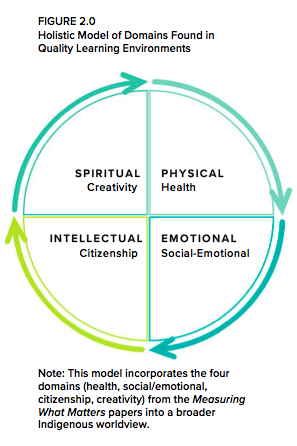
What is a quality learning environment? How do Indigenous worldviews reflect this concept? Are there particular components that make up this type of teaching/learning setting?
When we integrate and truly embed indigenous pedagogy, relevant curriculum content and the medicine wheel we are all components of student success and a quality learning environment.


 [1] Toulouse. P. What matters in Indigenous education: Implementing a Vision Committed to Holism, Diversity and EngagementOnline.  https://peopleforeducation.ca/report/what-matters-in-indigenous-education/ Accessed February 12, 2019. 


Decolonize and Indiginize

My role in reflecting on my practises  as an educator include thinking about decolonizing the curriculum.    The term "decolonize" has been widely used by non- indigenous people who have experienced colonization in their ancestral lands.  How can I focus and center my teaching on indigenous knowledge?  Can this fit into every subject?  There has been a lot of talk about museums, teachers college and other facets of teaching to decolonize their material.  

Under the Indian Act, the Potlach ban legally denied and actually criminalized Indigenous people for any expression of their traditions, ceremonies and caused tremendous harm to generations of families, communities and our nation. [1]
What I do today or tomorrow will never make up for those 67 years of loss and hurt but it can help to repair and rebuild for this generation and the future.   

I wish I had some of this knowledge when I went to teachers college in 2006.  Lorna Williams at the University of Victoria is looking at decolonizing Teacher Education programs.  She states that in
Indigenous education can provide alternative perspectives and reshape our thinking about how preservice teachers can better prepare themselves for a teaching career. Using principles such as those listed below which were realized by Lorna Williams (2008) in her course, Teaching and Learning in an Indigenous world.  
 These include the need to provide:

  • respectful and welcoming learning environments;
  • respectful and inclusive curricula;
  • culturally responsive pedagogies to improve the quality of knowledge, understanding, and pedagogic skills that all educators gain;
  • mechanisms for valuing and promoting Indigeneity in education; and
  • culturally responsive assessment (Archibald, Lundy, Reynolds, & Williams, 2010, pp. 5-8). [2] 


[1] [Online.]  Accessed at https://medium.com/viewfinder-reflecting-on-museum-education/decolonize-and-indigenize-a-reflective-dialogue-3de78fa76442.  February 19,2019. 

[2] Sandford. K. (2012). Indigenous Principles Decolonizing Teacher Educaion:  What we have learned.  InEducation. Vol 2. Issue 18.  

Monday, February 11, 2019

What does it look and sound like?

[2] 

As someone who has a passion for early learning this video is a wonderful representation of what I aspire my classroom to look like one day.  Have you taken a look at the Early Learning and Childcare Framework?  This framework provides a guide for communities, program administrators, service providers, policy makers and governments to work towards achieving a shared vision that all indigenous children have an opportunity to experience high quality and cultural strong early learning child care. [1] Indigenous students who attend this program and setting would be well supported and would support their long term development and life outcomes.  

Although cliche its true that children are future. We have an opportunity here to really embed a culture of acceptance, understanding, and compassion.  A new era of Truth and Reconciliation and give all children a strong sense of identity and Canadian history. This holistic approach that includes indigenous cultures and languages and community members should be what other programs are using as a measure of  success, and something to strive for.  

[1][Online]  https://www.canada.ca/en/employment-social-development/programs/indigenous-early-learning/2018-framework.html. Accessed; January 20,2019.  
[2] 


Sunday, February 10, 2019

Native History

20 years ago I was given two highschool course options.  I could take a Native History course or I could take a Canadian History course.  I choose the Native History course.  I remember learning about small pox and treaties, I remember learning about different tribes and the houses they built.   I vividly remember  our field trip to the Museum of Civilization in Ottawa.  For the life of me I could never understand why Canadian History and Native History were two separate entities?  Indigenous people are our countries history.

We, (Ontario) need to approach indigenous culture with the same dedication we apply to French Language. Courses in highschool should not be optional when it comes in indigenous content. It shouldn't matter what size of population of the school self identitifes as indigenous.  "Having students learn about the indigenous people of Canada provides an equal or even greater purpose- educating non-indigenous students.  Misconceptions of treaties, the water crisis, missing women, the 60's scoop and poverty on reserves.  The list goes on and on.  Not understanding what they things really are and how they have affected our communities has led to a divide."[1]

What are your thoughts?  What courses were offered to you in your educational journey?


[1] McMullen. C (2018) Ontario needs to Indigenize the Ontario Curriculum. [Online] https://chronicle.durhamcollege.ca/2018/01/ontario-needs-indigenize-ontario-curriculum/. Accessed January 20, 2019.